

“La Granja, Ability Training Center“, la primera granja escuela con un Método de Educación Emocional registrado y con resultados demostrados científicamente*.
Método la granja©
Un verdadero acelerador de competencias
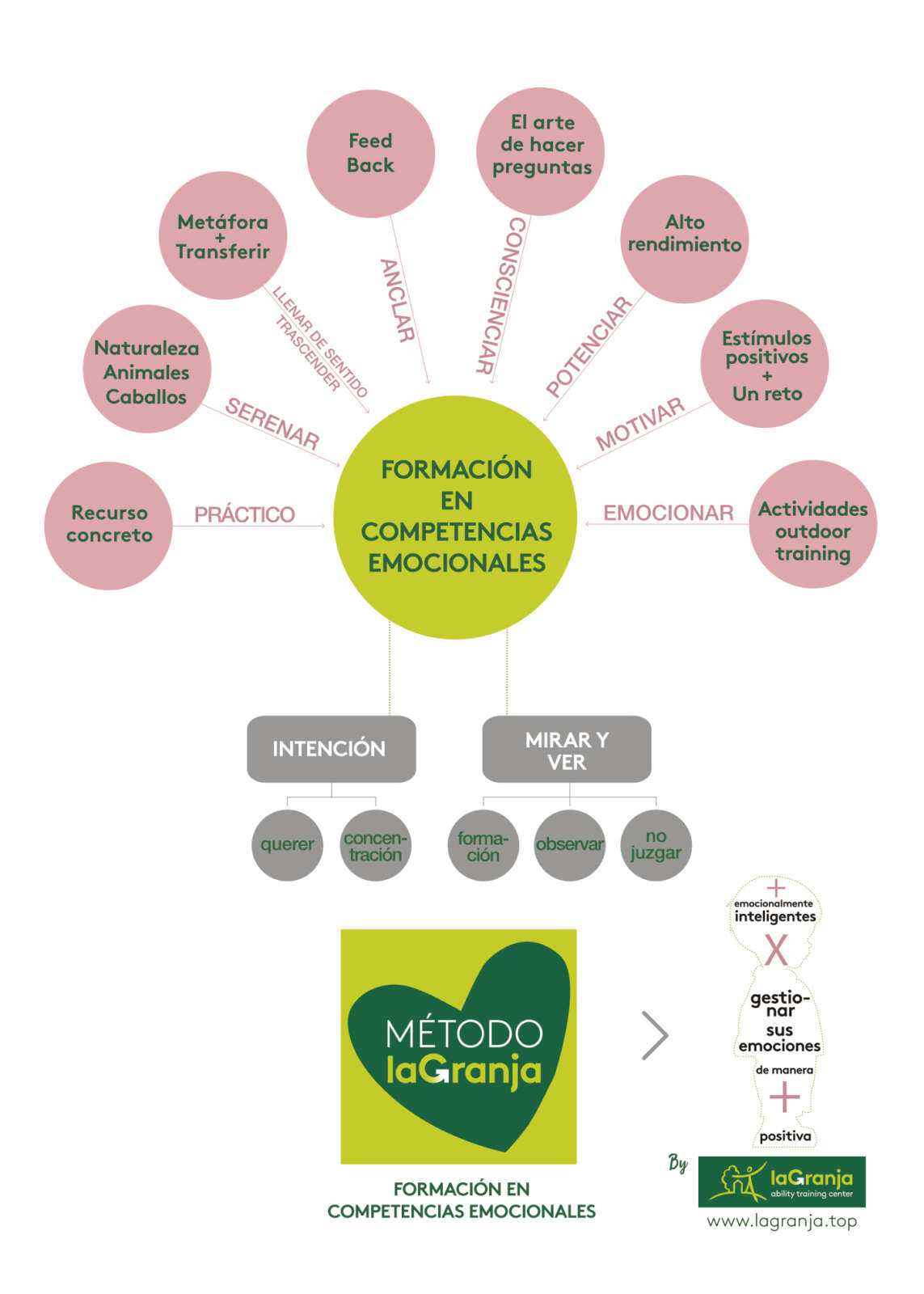
El objetivo del Método es entrenar las competencias emocionales de los alumnos, y la forma más potente de conseguirlo es mediante las actividades formativas Outdoor debido a su alto impacto y la facilidad que tiene para emocionar a los niños, jóvenes e incluso a los adultos. Detrás de cada dinámica o actividad hay una intención concreta, lo cual nos ayuda a conseguir el objetivo propuesto. Para motivar buscamos provocar la emoción de la alegría, la más motivadora que tenemos los humanos, utilizando la propuesta de retos y los estímulos positivos de manera continua. Para potenciar el Método y conseguir resultados en menos tiempo, utilizaremos el alto rendimiento gracias al diseño del programa y la actitud de concentración en el aquí y ahora de los Educadores Emocionales. El arte de hacer preguntas consigue que los alumnos hagan consciente lo inconsciente, y el feed back los ayuda a anclar los aprendizajes. La Metáfora permite trabajar desde el inconsciente para llenar de sentido aquello que ocurre en la actividad, y las transferencias consiguen que aquello aprendido trascienda a su vida diaria, en clase y en casa. Por último, la naturaleza y los animales ayudan a tranquilizar a los niños y jóvenes para apearlos durante unas horas de la aceleración del mundo.
El Método se está probando con más de 18.000 alumnos anuales desde el año 2008 y se basa en el marco teórico de las cinco competencias emocionales de Rafael Bisquerra (Bisquerra y Pérez 2007) de la Universidad de Barcelona: conciencia emocional, regulación emocional, autonomía emocional, competencias sociales y habilidades para la vida y el bienestar. Los resultados del Método La Granja© han sido evaluados y demostrados científicamente.
Publicación científica del método La Granja©
Our study "Innovation of emotional education in educational leisure: the La Granja Method" published in Revista de Investigación Educativa, 38(2), 495-513. DOI: http://dx.doi.org/10.6018/rie.405721. These are the authors: Gutiérrez-Lestón, C., Pérez-Escoda, N., Reguant, M. and Eroles, M. (2020).
*Impacto del Método La Granja© realizado por el GROP, grupo de investigación en Orientación Pedagógica de la Universidad de Barcelona (Noviembre 2017), sobre una muestra de 132 niños y jóvenes. El Estudio cuantitativo y cualitativo demuestra cambios significativos entre el antes y el después en las 5 dimensiones de las competencias emocionales (conciencia, regulación, autonomía, competencia de vida y de bienestar). Así mismo el estudio evalúa la ansiedad de los alumnos, demostrando una bajada significativa en los valores de la ansiedad estado y de la ansiedad rasgo.
¿Qué te llevas de estos días?
la vergüenza no existe, está en la cabeza.
Ariel, 7 años
he aprendido a conocerme mejor cuando me enfado.
Marina, 25 años
el conflicto es como el frío, ¡incomoda!
Laura, 12 años
de hoy me llevo saber que le importo a alguien.
Isaac, 12 años
He aprendido a perdonarme a mí mismo.
Óscar, 9 años
Sólo yo decido mis retos.
Dayani, 10 años
Tenemos magia por cambiar las emociones de los demás.
Berenguer, 8 años
He aprendido a conocerme mejor cuando me enfado.
Paula, 12 años
Descalza en el bosque me he sentido como si todo el mundo desapareciera y sólo existiéramos el bosque y nosotros en el universo…
Julia, 12 años
He entendido que cuando me enfado tengo el cerebro reptiliano en pleno funcionamiento
Gael, 8 años
Ante las cosas difíciles, si lo intento una y otra vez ya no es tan difícil.
Lluís, 10 años
He visto que debo hacerme responsable de lo que hago yo sin echar la culpa a los demás
Meritxell, 9 años
Hoy he aprendido que la belleza exterior es la que nos toca, y la interior es la que nos curamos
Gerard, 14 años
¡Me dibujé de muchos colores por qué tengo muchas emociones y sensaciones!
Cristina, 9 años
Me ha gustado tener la oportunidad de confiar en aquellos compañeros que no se me caen muy bien
Jana, 6 años
Me llevo la semilla de la paciencia, porque a veces estoy tan nervioso, que el día se me hace largo
Nico, 9 años
Scientific publication of the La Granja Method
Our study "Innovation of emotional education in educational leisure: the La Granja Method" published in Revista de Investigación Educativa, 38(2), 495-513. DOI: http://dx.doi.org/10.6018/rie.405721. These are the authors: Gutiérrez-Lestón, C., Pérez-Escoda, N., Reguant, M. and Eroles, M. (2020).
The result of the La Granja Method is reflected in the Study of the Impact of the La Granja Method© conducted by the GROP, Grup de Recerca en Orientació Pedagògica of the University of Barcelona (November 2017), on a sample of 132 children between 8 and 14 years old. The quantitative and qualitative study demonstrates significant changes between before and after in the 5 dimensions of emotional competencies (awareness, regulation, autonomy, life competence and well-being). Likewise, the study evaluates the anxiety of the students, showing a significant decrease in the values of state anxiety and trait anxiety after the camp.
Quantitative results: Here is part of the quantitative scientific study carried out by GROP Aquí tenéis parte del estudio científico cuantitativo realizado por el GROP
Evolution of emotional competencies according to CDE.
After obtaining a (p>, 05) in all variables in the Kolmogorov-Smirnov and Levene test, we proceeded to apply the related samples t-test between the initial and final situation. As shown in Table 1, both in total emotional competence and in its five dimensions: awareness, regulation, autonomy, social competences and life and well-being competences, the scores in the post-test phase, after their participation in the Casal, have increased.
Table 1. Evolution of emotional competences pre-post (CDE)
Media
DT.
t
Sig.
d COHEN
Pre-Total Comp.Emocional
6,73
6,73
6,73
6,73
6,73
Postest_Total
7,07
1,07
Pre-Consciència
7,46
1,36
-2,76
0,007
-0,18
Postest_Consciència
7,71
1,35
Pre-Regulació
5,69
1,43
-5,05
0,000
-0,40
Postest_Consciència
5,69
1,43
-5,05
0,000
-0,40
Pre-Autonomia
5,69
1,43
-5,05
0,000
-0,40
Postest_Autonomia
7,71
1,35
Pre-Compsoci
5,69
1,43
-5,05
0,000
-0,40
Postest_Compsoci
7,71
1,35
Pre-Cvida
5,69
1,43
-5,05
0,000
-0,40
Postest_Cvida
7,71
1,35
N=127
As we can see, the difference in total emotional competence is produced with a significance level of ,000 in favor of the final situation, so we can affirm that there are improvements between before and after their time at La Granja.
When we analyze the progress in the different dimensions evaluated, we observe that in all cases, except in life skills and well-being, the changes observed are statistically significant with a probability between p = .000 and p < .014 and also in favor of the final situation, that is, indicating an improvement in the level of development of these skills. In addition to the contrast of means, we proceeded to calculate the magnitude of these changes, for which we studied Cohen's d, also presented in Table 1. The results show changes very similar to those that are common as a consequence of training processes (Rosenthal, 1996), with a magnitude of around ,30 in total emotional competence, and in the dimensions of emotional regulation and autonomy.
Qualitative study, conducted by the GROP of the University of Barcelona.
Perception of learning
As a result of the lexicometric analysis, the most frequently used terms after their passage through La Granja are: learn, do and people, followed by other links in the center of which are the words: a lot, know, trust, friend, and will be useful.
In the particular analysis of each of these nodes, there are also interesting coincidences that are significant, for example: know, listen, happy, happiness, express, share, as associated words. Another chain of words, associated in this case with "person" are: power, team, work, judge, on the one hand, and opportunity, give, opinion, truth, on the other. All of them have a high propositional content and have to do with the educational program of La Granja.
The great central node is the word "learn" surrounded by others such as: emotion, fear, problem, need, value, control, face and pass. All of them seem to allude to the inner world or personal control, aspects that are intentionally worked on in the activities of the emotional house of the Farm and that constitute a real need, although not always felt and/or declared during childhood and adolescence.
Another central node arises around the term "people", this word is mainly linked to know and it is that, frequently, it is alluded to meet new people, make friends. The words that immediately appear are: relate, easy, easily, easily, talk, want, respect, live together, want, feel, experience. In the same line of words that appear are: much, life and important, words associated with empathize, world, experience, adventure. It is interesting to see the analogy between this community of terms and the experience lived in the emotional house, in contact with the forest, with the animals and especially with others in a different form of relationship to the one they usually have.
The third and last nucleus is "doing". We believe that this is linked, again, with experience, autonomous and personal doing, which is confirmed by some of the immediate terms such as fun, joy, happy, joyful, safe, I will be able to, confidence, self, self-esteem or believe. There are also a number of associated terms such as: think, feeling or help and that seem to connect with a less active and more reflective doing.
The quantitative results observed allow us to point out that, indeed, there has been an improvement in emotional competence, especially in regulation (d=.40) and emotional autonomy (d=.30), followed by social competence (d=.18).
The qualitative data also point in this direction, highlighting, on this occasion, a greater number of comments referring to social competence, followed by those referring to learning related to regulation and the development of emotional autonomy.
¿Cómo explicarte cómo lo hacemos?
Una imagen vale más que mil palabras. Así somos y así entrenamos competencias emocionales:
La Granja Escuela Educación Emocional – Método La Granja
Quieres saber qué hacemos en La Granja y, lo más importante, cómo lo hacemos. Con este vídeo lleno de testimonios de niños, padres y educadores emocionales te lo contamos.
Masia 360 – Educación emocional
Entrenar para la vida, un programa formativo que permite entrenar las competencias emocionales de forma práctica y vivencial.
What is La Granja Ability Training Center?
At La Granja we are experts in Applied Emotional Education and pioneers in creating a Method with scientifically proven results.
Congresos donde se ha presentado el “Método La Granja©”

"Unesco 2022", "World Conference on Higher Education". Barcelona.
Participation with the poster "Emotional and Social Skills Training in Children with Neurofibromatosis Type 1" at the 2020 International Neurofibromatosis Medical Congress, in collaboration with Sant Joan de Déu Hospital in Barcelona and La Granja Ability Training Center.

"CINAIC, V International Congress on Learning, Innovation and Cooperation". Presenting the paper "An experience of emotional education in the urban summer camp of La Granja Escuela: an innovation in the field of educational leisure." (Madrid, 2019). You can watch the VIDEO of the PRESENTATION HERE.

“AIDIPE 2019, XIX International Congress of Educational Research”. Workshop presentation “Educating Emotions from the Classroom to Transform the World” (Madrid, 2019).

2019 Annual Neurofibromatosis Congress, presenting the results of the studies from the project carried out in collaboration with the Hospital Sant Joan de Déu of Barcelona. Conference: “How to Develop Emotional Competencies in Children and Adolescents Affected by NF1?” (results from BRIEF, CDE, and ADHD).

"XV Emotional Education Conference 2019." Training the Educator in Emotional Education. University of Barcelona/ICE. Workshop: "Training in Emotional Educator Stages. The La Granja Experience."

"XIV Emotional Education Conferences, 2014, 2015, 2016, 2017. University of Barcelona/ICE." Presentation: "An Emotional Education Experience at the La Granja Summer Camp: An Innovation in the Field of Educational Leisure." And the Workshop: "Emotional Education: From Educational Leisure to the Classroom." (Barcelona 2018). III, IV, V, and VI Henry Dunant Congress. Caixa Fórum.